







Embodied Carbon in the Built Environment | OCBC Singapore
Now reading:

Embodied carbon: Revealing unseen emissions in the built environment

Embodied carbon: Revealing unseen emissions in the built environment

  • January 2026
  • By OCBC Group Research
  • 10 mins read

Summary

The built environment accounts for around 40% of global carbon emissions, with embodied carbon being especially critical with the rising demand for construction materials. The cement and steel sectors’ low-carbon transition can be accelerated through scaling low-carbon solutions, harmonising standards, prioritising embodied carbon reduction, as well as bridging the price gap between green and conventional construction materials.

What is embodied carbon?

Emissions in the built environment comprise two types:

  1. Operational carbon, associated with the energy used to operate the building (including fugitive refrigerant emissions), and
  2. Embodied carbon, associated with materials and construction processes over a building’s lifetime.

Nearly one third of all building-related emissions stem from embodied carbon, which accounts for around 10% of all energy-related greenhouse gas emissions worldwide, according to the World Green Building Council.

The proportion of embodied carbon in the built environment could increase to around 50% by 2035, as operational emissions of buildings decrease due to rising operational efficiency, according to the Global Real Estate Sustainability Benchmark (GRESB). Operational carbon has received more attention through policies and targets addressing buildings’ energy efficiency, whereas embodied carbon faces challenges such as a lack of reliable emissions data for building materials. Nonetheless, its importance in assessing the climate impact of the built environment is growing, as it has become a material issue for developers and investors.

Concrete and steel as major contributors to embodied carbon

Building elements such as foundations, frames and other forms of superstructure represent the largest proportion of embodied carbon in the built environment. These materials are used in large volumes and often contain emissions-intensive materials such as concrete and steel. These hard-to-abate construction materials are particularly difficult to decarbonise due to the nature of their production processes, where emissions result from both chemical reactions and the high temperature heat requirements that to date rely mainly on fossil fuels:

  • Concrete is a composite material primarily made of coarse and fine aggregates, cement and water. Approximately 90% of total carbon emissions from concrete production comes from cement production due to its manufacturing process. The calcination process from heating limestone to produce clinker releases CO2, while fossil fuel combustion used to reach the high temperatures (~1,450°C) required in kilns contributes significantly to emissions.
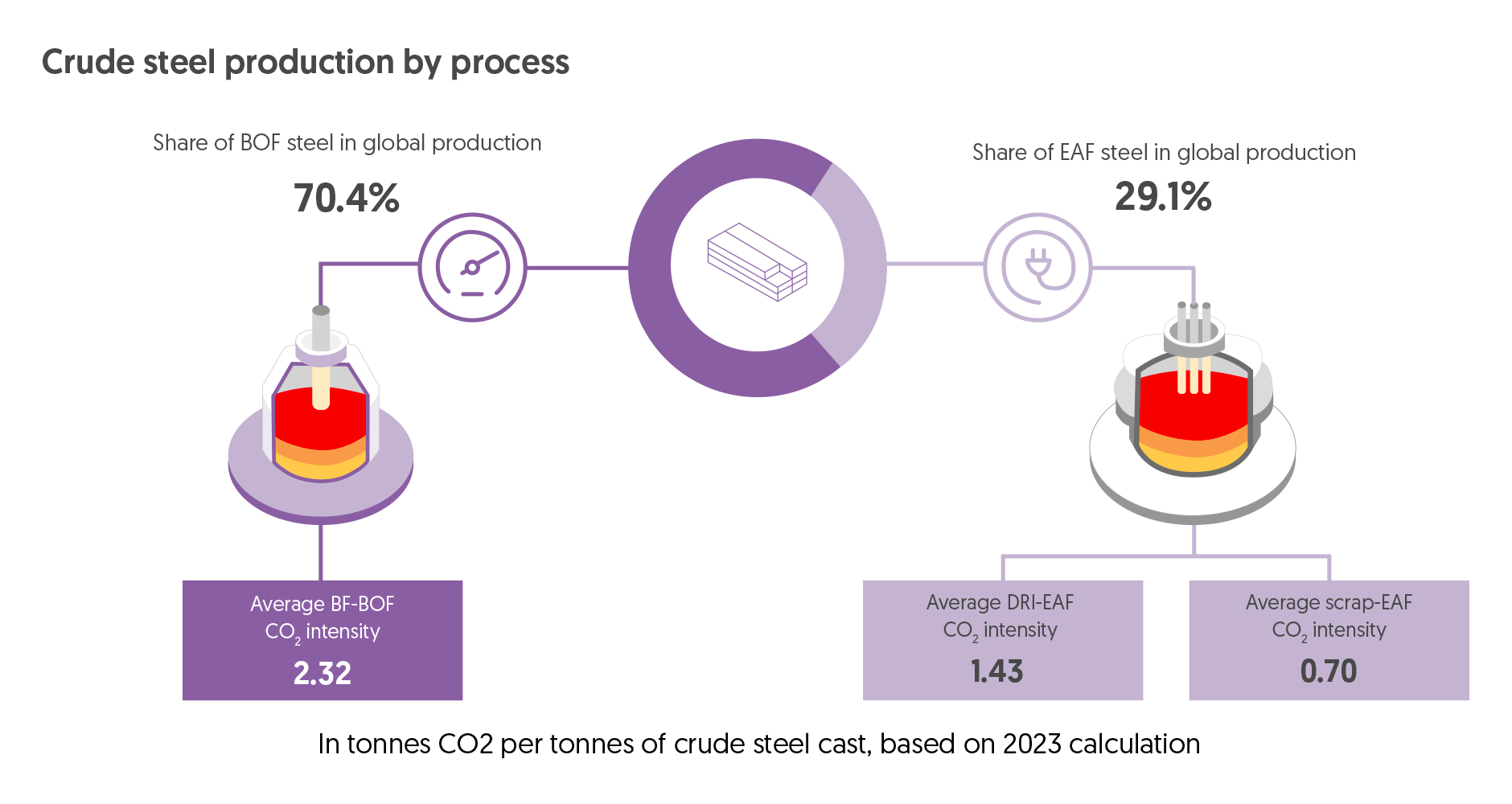
  • The production of steel currently accounts for 7–8% of emissions globally. The prevailing steelmaking method, blast furnace–basic oxygen furnace (BF-BOF), relies heavily on coal used as a reducing agent to extract iron from iron ore. While BF-BOF accounts for around 70% of global steel production and remains cost-effective, it is also the most emissions-intensive.

Divergence in standards on what constitutes low-carbon concrete and steel

Decarbonising concrete and steel production is critical to achieving national and global climate goals, and low-carbon alternatives to conventional production already exist. Low-carbon pathways to concrete production include: (i)reducing conventional Portland cement use by substituting with low-carbon alternatives or supplementary cementitious materials or using recycled aggregates (iii)fuel-switching to cleaner energy sources to reduce fossil fuel consumption. (iii)Deploying carbon mineralisation technologies to lower emissions intensity in the concrete manufacturing process. For steel, significant emission reductions can be achieved through increased adoption of technologies such as Direct Reduced Iron (DRI) and Electric Arc Furnace (EAF). Using scrap or recycled steel is another key lever for reducing emissions from the steelmaking process.
Source: World Steel Association

However, there is currently little consensus on what it means for concrete and steel to be considered ‘green’. Key indicators of green concrete have shifted from more prescriptive metrics e.g. % of recycled or clinker content, towards performance-based metrics e.g. carbon emissions intensity. For example, the Singapore Green Building Council (SGBC)’s Singapore Green Building Product (SGBP) Certification for Ready-Mix Concrete previously rated products based on clinker content but has recently changed the criteria to Global Warming Potential (GWP) measured in kgCO2e/m3 volume of concrete. However, even if emissions intensity is used as a common metric, the thresholds for what is considered ‘green’ vary across markets. For example, Hong Kong Construction Industry Council’s (CIC) Green Product Certification considers concrete to be ‘best-in-class’ if it produces less than 206 – 375 kgCO2e/m3, while the Global Cement and Concrete Association’s Global Ratings for Concrete has much stricter guidelines: to earn an A-grade or better rating, concrete must produce less than 68 – 113 kgCO2e/m3, depending on the concrete strength grade. The thresholds used by different green product certification bodies and industry initiatives vary, as they cater to regional differences in material sources and conditions of production decarbonisation progress on a rating scale of Level 1 (basic) to Level 4 (near -zero), while considering the variable amounts of scrap used in steel production.

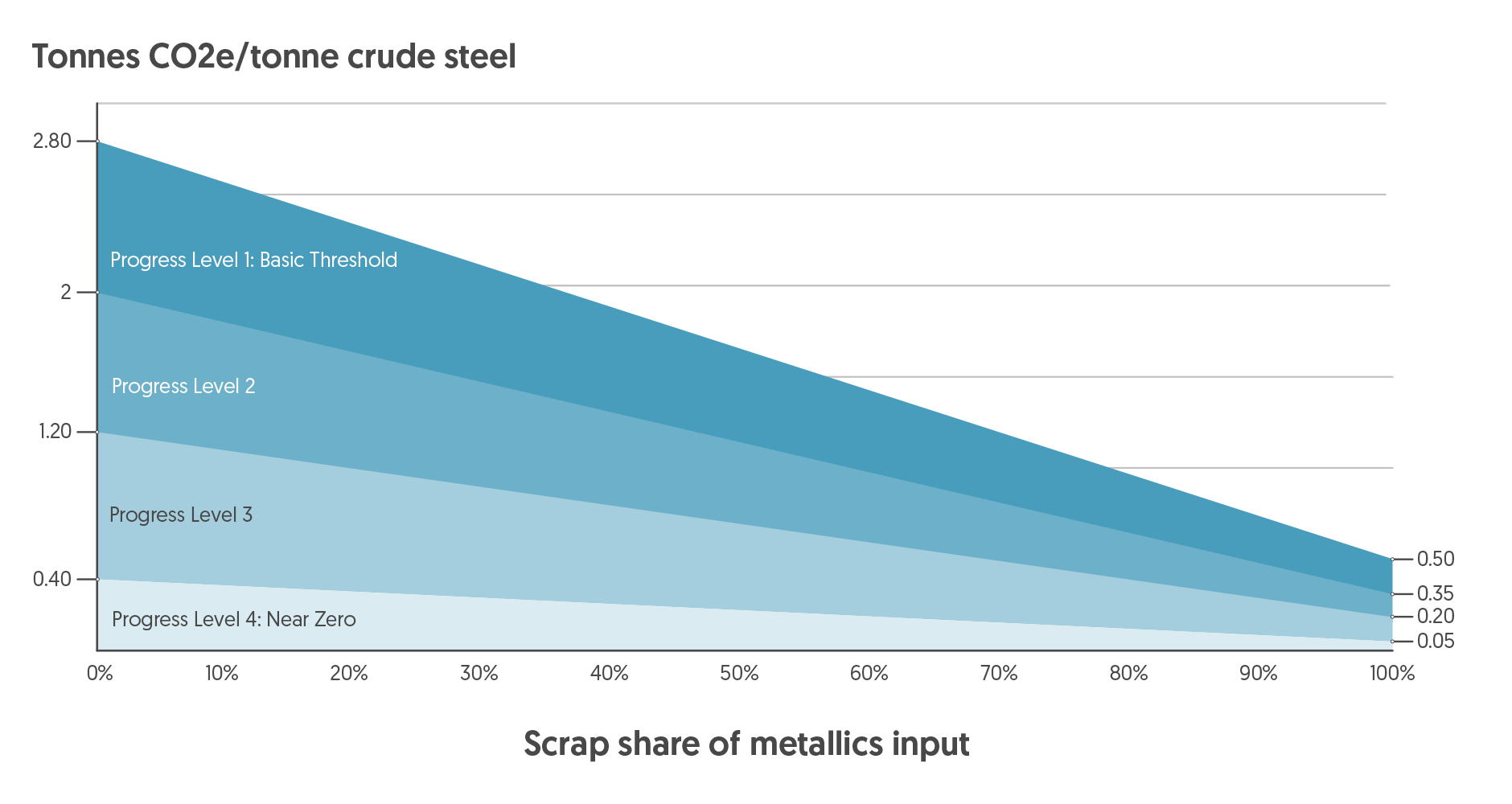
Similarly, for green steel, some adopt a stricter definition of ‘steel manufactured without the use of fossil fuels’, while others use the term ‘green steel’ or ‘low-carbon steel’ interchangeably to refer to steel produced with significantly lower emissions than BF-BOF (such as natural-gas based DRI-EAF). Globally, there is a proliferation of standards and initiatives attempting to define what low-carbon steelmaking means. For example, ResponsibleSteel, the industry’s first global standard and certification programme, uses a ‘sliding-scale approach’ (see Figure below), which assesses the level of decarbonisation progress on a rating scale of Level 1 (basic) to Level 4 (near-zero), while considering the variable amounts of scrap used in steel production.
Source: Responsible Steel International Production Standard Version 2.1

In the finance sector, the EU Taxonomy for Sustainable Activities uses emission intensity (tCO2e/t product) thresholds as a key metric to define what is ‘green’ steel, although these thresholds do not vary based on scrap volume. In the end-use sectors, Ste elZero (a corporate initiative aimed at boosting demand for low carbon steel) adopts ResponsibleSteel’s ratings, but also includes ‘steel produced by a steelmaker with a science-based emissions target’ in its definition of ‘lower emission steel’, signalling acceptance of forward-looking emissions targets rather than actual performance. 

The lack of harmonised definitions for green concrete or steel often creates confusion for contractors or project owners making purchasing decisions. Recognising this challenge, the industry is increasing efforts to enhance alignment and enable interoperability between frameworks and standards. One recent example is the agreements announced at COP30 in Belem, Brazil between ResponsibleSteel, the China Iron and Steel Association (CISA) and Europe’s Low Emission Steel Standard (LESS). The three organisations collectively cover around 60% of the world’s steel production, and the agreements are aimed at advancing global comparability and trade in low-carbon steel.

Price premium of green materials

The price premium for green materials remains a key barrier to adoption in the built environment, in addition to the lack of consensus on clear definitions and standards. The International Energy Agency (IEA) estimates that the production costs of near-zero crude steel carry a 10% to 75% premium compared to conventional crude steel production costs at present, varying with technology types and regional factors such as energy and labour costs. This translates to approximately US$225/t of crude steel in 2030, which is a 40% premium compared to current conventional crude steel. 

Similarly, the production cost of near-zero cement will typically carry a premium of 30% to 125% compared to current conventional cement production costs, depending on regional and technological factors. This translates to an average premium of US$60/t of cement globally, which is 75% higher than current conventional cement. This implies that for concrete, the premium is likely to be lower, since cement accounts for a portion of concrete production costs and it can be substituted with other supplementary cementitious products. However, low-carbon concrete is still estimated to carry a 15% to 40% premium and this range differs across markets. 

While some buyers have indicated a willingness to purchase low-carbon materials in the built environment, they are unable to do so due to insufficient availability on the market. These buyers do not have the scale to generate strong demand signals and are unable to take on the full risk needed to establish robust markets for green materials. Certain buyers may only be willing to partially cover the price premium, thereby requiring support through other means to close the gap. On the other hand, it may be difficult for suppliers to justify upfront CAPEX investments needed for low-carbon materials production without certainty in demand and offtake price. To bridge the price gap, government-led measures can alleviate some of the risk and cost burden faced by early movers.

Policies and regulations driving the built environment’s low-carbon transition

1. EU Carbon Border Adjustment Mechanism (CBAM)

The EU introduced CBAM in 2023 as a climate policy designed to level the playing field between the EU and third-country producers, by putting a fair price on carbon on certain imported products (including cement and steel) while phasing out free allocation of emissions allowances to the European industry. The EU CBAM is a carbon leakage instrument that functions in tandem with the EU Emissions Trading System (EU ETS), that requires EU importers to purchase CBAM certificates equivalent to the weekly average auction price of EU allowances.

During the EU CBAM’s transitional phase (2023–2025), importers of goods in the scope had to report their emissions embedded in their imports and did not have to buy and surrender CBAM certificates. The EU CBAM entered its definitive regime on 1 Jan 2026, where EU importers will have to declare their emissions embedded in their imports and pay a levy on certain products e.g. cement and steel.

Cement and steel producers that export products to the EU face the choice of paying higher carbon costs or reducing carbon emissions embedded in their products. The EU CBAM thereby incentivises the industry to produce low-carbon cement and steel to reduce carbon costs, as low-carbon cement and steel.

2. China Emissions Trading System (ETS)

China, the single largest producing country for both cement and steel, is also introducing carbon pricing to curb emissions from the production of these two materials. Prior to 2024, China’s ETS only included the power sector. In 2024 (following the introduction of EU CBAM), China’s Ministry of Ecology and Environment (MEE) announced the expansion of the national ETS to the aluminium, steel and cement sectors.

According to the latest work plan released by MEE, in 2026 and 2027, companies in the new sectors need to pay retrospectively for their emissions incurred in 2025 and 2026 respectively. In the initial years, companies will be given free China Emission Allowances (CEAs) that do not deviate too much from their actual emissions, limiting any immediate impact on the cost of production. However, MEE said that the carbon intensity benchmarks will be gradually tightened from 2028 onwards, which is expected to make it tougher for low-efficiency producers to survive in a highly competitive market with overcapacity issues. Carbon pricing mechanisms such as the China ETS can also increasingly bridge the price gap between low-carbon and emissions-intensive production, largely by increasing the cost of conventional and higher-emitting production.

3. Building Sector Policies and Standards

The building and construction sector is the single largest end-use sector for cement and steel, consuming about 50% of total steel (World Steel Association) and vast majority of total cement produced. Embodied carbon policies in the sector play a key role in shaping the demand for low-carbon concrete and steel. Currently, embodied carbon regulatory policies differ across markets, depending on the capacity and maturity of the local industry.

Several countries have mandated or proposed embodied carbon reporting for the building and construction sector as part of their climate-related disclosure regulations. For example, from 2028, all EU member states must report embodied carbon for major construction projects. This requirement will be extended to all projects by 2030, together with the introduction of specific embodied carbon limits. Some countries incorporate embodied carbon assessments and reporting in their legislation and building code. For example, Denmark has introduced carbon limits for new buildings (including embodied carbon emissions) since 2023. In Singapore, it is mandatory for developers to address embodied carbon emissions as part of the Code for Environmental Sustainability of Buildings.

Apart from national-level policies, several green building standards globally have started incorporating embodied carbon as part of their certification requirements. For example, Green Star Buildings has a minimum expectation on projects to have 10% less upfront carbon emissions compared to a standard building from materials. For BREEAM New Construction, in order to attain higher ratings of ‘Excellent’ and ‘Outstanding’, project-stage lifecycle assessment and embodied carbon reporting are required. Other standards have target thresholds of embodied carbon performance where attainment allows for points to be awarded. For example, in LEED certification criteria, projects can earn credits based on their ability to reduce GWP. In Singapore’s Green Mark’s Whole Life Carbon section, additional points can be scored when project teams report and promote the reduction of whole life carbon in their projects. Various calculation tools have also been developed to support embodied carbon reporting, such as the Embodied Carbon in Construction Calculator (EC3) tool, Singapore Building Carbon Calculator (SBCC) and NABERS Embodied Carbon tool.

Looking ahead

Scaling markets for low-carbon cement and steel can contribute to achieving global climate goals. The pace and success of the cement and steel sectors’ transition to low-carbon pathways will be shaped by factors including:

  • Technological advancements that enable scalable low-carbon solutions, such as carbon capture utilisation and storage (CCUS) and commercially available low-carbon hydrogen for steel and cement production;
  • Increasing alignment and enabling interoperability between frameworks and standards for low-carbon materials;
  • The degree to which major end-use sectors, in particular buildings and infrastructure, prioritise reducing embodied carbon; and
  • The evolution of carbon pricing mechanisms across both producing and purchasing countries, and how this can bridge the price gap between conventional and low-carbon materials.

The transition to low-carbon cement and steel could trigger a reshaping of the global supply chain for building materials. New manufacturing hubs are also emerging, such as those in the Middle East leveraging abundant natural gas as a cost advantage to produce DRI. Understanding the interdependencies among these factors is critical for assessing potential pathways and investment opportunities in these key industries.

Important information

This advertisement has not been reviewed by the Monetary Authority of Singapore.

General Disclaimers

  1. Any opinions or views of third parties expressed in this document are those of the third parties identified, and do not represent views of Oversea -Chinese Banking Corporation Limited (“OCBC Bank ”, “ us ”, “ we ” or “ our ”).
  2. This information is intended for general circulation and / or discussion purposes only. It does not consider the specific investment objectives, financial situation or needs of any particular person.
  3. Before you make an investment, please seek advice from your Relationship Manager regarding the suitability of any investment product taking into account your specific investment objectives, financial situation or particular needs.
  4. If you choose not to do so, you should consider if the investment product is suitable for you, and conduct your own assessments and due diligence on the investment product.
  5. We are not making an offer, solicit to buy or sell or subscribe for any security or financial instrument, enter into any transaction or participate in any trading or investment strategy with you through this document. Nothing in this document shall be deemed as an offer or solicitation to buy or sell or subscribe for any security or financial instrument or to enter into any transaction o r to participate in any particular trading or investment strategy.
  6. No representation or warranty whatsoever in respect of any information provided herein is given by OCBC Bank and it should not be relied upon as such. OCBC Bank does not undertake an obligation to update the information or to correct any inaccuracy that may become apparent at a later time. All information presented is subject to change without notice.
  7. OCBC Bank shall not be responsible or liable for any loss or damage whatsoever arising directly or indirectly howsoever in connection with or as a result of any person acting on any information provided herein.
  8. Investments are subject to investment risks, including the possible loss of the principal amount invested. The information provided herein may contain projections or other forward -looking statements regarding future events or future performance of countries, assets, markets or companies. Actual events or results may differ materially. Past performance figures, predictions or projections are not necessarily indicative of future or likely performance.
  9. Any reference to a company, financial product or asset class is used for illustrative purposes and does not represent our recommendation in any way.
  10. The information in and contents of this document may not be reproduced or disseminated in whole or in part without the Bank’s written consent.
  11. OCBC Bank, its related companies, and their respective directors and/or employees (collectively “Related Persons”) may, or might have in the future, interests in the investment products or the issuers mentioned herein. Such interests include effecting transactions in such investment products, and providing broking, investment banking and other financial services to such issuers.
  12. OCBC Bank and its Related Persons may also be related to, and receive fees from, providers of such investment products. You must read the Offer Document/Indicative Term Sheet/Product Highlight Sheet before deciding whether or not to purchase the investment product, copies of which may be obtained from your relationship manager.
  13. Any hyperlink to any third -party article, or other website or webpage (including any websites or webpages owned, operated and maintained by third parties) is for informational purposes only and for your convenience only and is not an endorsement or verification of any such article, website or webpage by OCBC Bank and should only be accessed at your own risk. OCBC Bank does not review the contents of any such articles, website or webpage, and shall not be liable to any person for the same.
  14. In the event of links or hyperlinks which link you to websites of other third parties (the “Third Parties”), OCBC Bank hereby disclaims liability for any information, materials, products or services posted or offered on the website of the Third Parties.

Foreign Currency

  1. Foreign currency investments or deposits are subject to inherent exchange rate fluctuation that may provide opportunities and risks. Consequently, exchange rate fluctuations may affect the value of your foreign currency investments or deposits.
  2. Earning on foreign currency investments or deposits may change depending on the exchange rates prevalent at the time of their maturity if you choose to convert.
  3. Exchange controls may apply to certain foreign currencies from time to time.
  4. Any pre-termination costs will be taken and deducted from your deposit directly and without notice.

Global Equities Disclaimer

  1. Dividend growth is not guaranteed, nor are companies in which you invest obliged to pay dividends;
  2. Companies may go bankrupt rendering the original investment valueless;
  3. Equity markets may decline in value;
  4. Corporate earnings and financial markets may be volatile;
  5. If there is no recognised market for equities, then these may be difficult to sell and accurate information about their value may be hard to obtain;
  6. Smaller company investments may be difficult to sell if there is little liquidity in the market for such equities and there may be substantial differences between the buying price and the selling price;
  7. Equities on overseas markets may involve different risks to equities issued in Singapore;
  8. With regards to investments in overseas companies, foreign exchange rates may move in an unfavourable direction affecting
  9. adversely the valuation of investments in base currency terms.

Dual Currency Returns

  1. By buying Dual Currency Returns, you are giving us the right to repay you at a future date in a different currency from the currency in which you made your original investment, even if you would prefer not to be paid in this currency at that time. Dual Currency Returns are affected by foreign exchange rates, which may affect how much you get back from your investment. You may receive less than you originally invested.
  2. Foreign exchange control restrictions may apply to the foreign currencies linked to your Dual Currency Returns. As a result, we may repay your investment and interest in a different currency. You may receive less than you originally invested when the amount of this different currency is converted back to the base currency (the currency you originally invested). You may be able to get information on foreign exchange control restrictions, if any, for each foreign currency offered in relation to Dual Currency Returns, from the relevant monetary, regulatory or other governmental authorities for that currency.
  3. We will not end Dual Currency Returns before the maturity date (the date they are due to end). You may, however, withdraw the amount you originally invested before the maturity date. If you do this, please remember that you will have to pay any charge s that apply which are calculated based on the amount of the time remaining before maturity date, as well as current market conditions relating to strike prices, foreign exchange rates and changes in the underlying foreign exchange pair. These charges may mean that you get back much less than you originally invested. Please feel free to approach your relationship manager for details of the procedures and charges that apply if you withdraw your Dual Currency Returns investment before the maturity date.
  4. Dual Currency Returns are not insured deposits for the purposes of the Deposit Insurance and Policy Owners’ Protection Schemes Act 2011 of Singapore.

Collective Investment Schemes

  1. A copy of the prospectus of each fund is available and may be obtained from the fund manager or any of its approved distributors. Potential investors should read the prospectus for details on the relevant fund before deciding whether to subscribe for, or purchase units in the fund.
  2. The value of the units in the funds and the income accruing to the units, if any, may fall or rise. Please refer to the prospectus of the relevant fund for the name of the fund manager and the investment objectives of the fund. 
  3. Investment involves risks. Past performance figures do not reflect future performance. 
  4. Any reference to a company, financial product or asset class is used for illustrative purposes and does not represent our recommendation in any way.
  5. For funds that are listed on an approved exchange, investors cannot redeem their units of those funds with the manager, or may only redeem units with the manager under certain specified conditions. The listing of the units of those funds on any approved ex change does not guarantee a liquid market for the units.
  6. Any indicative distribution rate may not be achieved and is not an indication, forecast, or projection of the future performance of the Fund.

Cross Border Market Disclaimers

  1. General: The document provided by Oversea-Chinese Banking Corporation Limited, Singapore (“OCBC Singapore”) is for general information only and is not intended for anyone other than the recipient. It does not take into account the specific investment objectives, financial situation or particular needs of any particular person, and does not constitute an offer or solicitation by OCBC Singapore to buy or sell or subscribe for any security or financial instrument or to enter into a transaction or to participate in any particular trading or investment strategy nor an advice or a recommendation with respect to such financial products. This document may not be published, circulated, reproduced or distributed in whole or in part to any other person without OCBC Singapore’s prior written consent. This document is not intended for distribution to, publication or use by any person in any jurisdiction, where such distribution, publication or use would be contrary to applicable law or would subject OCBC Singapore and its related corporations, connected persons, associated persons and/or affiliates to any registration, licensing or other requirements within such jurisdiction.
  2. Brunei: This document has not been delivered to, licensed or permitted by the Brunei Darussalam Central Bank, the authority as designated under the Brunei Darussalam Securities Markets Order, 2013 and the Banking Order, 2006; nor has it been registered with the Registrar of Companies, Registrar of International Business Companies or the Brunei Darussalam Ministry of Finance. The relevant securities or products are not registered, licensed or permitted by the Brunei Darussalam Central Bank or by any other government agency or under any law in Brunei Darussalam. Any offers, acceptances, sales and allotments of the relevant securities or products shall be made outside Brunei Darussalam.
  3. Hong Kong: The document provided by OCBC Singapore is for general information only and is not intended for anyone other than the recipient. It does not take into account the specific investment objectives, financial situation or particular needs of any particular person, and does not constitute an offer or solicitation by OCBC Singapore to buy or sell or subscribe for any security or financial instrument or to enter into a transaction or to participate in any particular trading or investment strategy nor an advice or a recommendation with respect to such financial products. This document may not be published, circulated, reproduced or distributed in whole or in part to any other person without OCBC Singapore’s prior written consent. This document is not intended for distribution to, publication or use by any person in any jurisdiction, where such distribution, publication or use would be contrary to applicable law or would subject OCBC Singapore and its related corporations, connected persons, associated persons and/or affiliates to any registration, licensing or other requirements within such jurisdiction.
  4. Indonesia: The offering of the investment product in reliance of this document is not registered under the Indonesian Capital Market Law and its implementing regulations, and is not intended to constitute a public offering of securities under the Indonesian Capital Market Law and its implementing regulations. According, this investment product may not be offered or sold, directly or indirectly, within Indonesia or to Indonesian citizens (wherever they are domiciled or located), entities or residents, in any manner which constitutes a public offering of securities under the Indonesian Capital Market Law and its implementing regulations. In compliance with the Indonesian Capital Market Law and Regulation of the Indonesian Financial Service Authority No.30/POJK.04/2019, the investment product in this document may not be distributed in Indonesian or to any Indonesian citizens (wherever they are domiciled or located), entities or residents. The investment product in this document has not been and will not be registered or filed with to the Indonesian Financial Service Authority.
  5. Japan: The information contained in this document is for general reference purposes only. It does not have regard to your specific investment objectives, financial situation, risk tolerance and particular needs. Nothing in this document constitutes an offer to buy or sell or an invitation to offer to buy or sell or a recommendation or a solicitation to buy or sell any securities or investment. You acknowledge that nothing in this document constitutes investment or financial advice or any advice of any nature.
  6. Labuan: OCBC Singapore does not hold any licence, registration or approval to carry on any regulated business in Labuan (including but not limited to any businesses regulated under the Capital Markets and Services Act 2007 and the Labuan Financial Services and Securities Act 2010 of Malaysia), nor does it hold itself out as carrying on or purport to carry on any such business in Labuan. Any services provided by OCBC Singapore to residents of Labuan are provided solely on an offshore basis from outside Labuan, either as a result of “reverse enquiry” on the part of the Labuan residents or where OCBC Singapore has been retained outside Labuan to provide such services. As an integral part of the provision of such services from outside Labuan, OCBC Singapore may from time to time make available to such residents documents and information making reference to capital markets products (for example, in connection with the provision of fund management or investment advisory services outside of Labuan). Nothing in such documents or information is intended to be construed as or constitute the making available of, or an offer or invitation to subscribe for or purchase any such capital markets product.
  7. Malaysia: OCBC Singapore does not hold any licence, registration or approval to carry on any regulated business in Malaysia (including but not limited to any businesses regulated under the Capital Markets and Services Act 2007 of Malaysia), nor does it hold itself out as carrying on or purport to carry on any such business in Malaysia. Any services provided by OCBC Singapore to residents of Malaysia are provided solely on an offshore basis from outside Malaysia, either as a result of “reverse enquiry” on the part of the Malaysian residents or where OCBC Singapore has been retained outside Malaysia to provide such services. As an integral part of the provision of such services from outside Malaysia, OCBC Singapore may from time to time make available to such residents documents and information making reference to capital markets products (for example, in connection with the provision of fund management or investment advisory services outside of Malaysia). Nothing in such documents or information is intended to be construed as or constitute the making available of, or an offer or invitation to subscribe for or purchase any such capital markets product.
  8. Myanmar: The provision of any products and services by OCBC Singapore shall be solely on an offshore basis. You shall ensure that you have and will continue to be fully compliant with all applicable laws in Myanmar when entering into discussion or contracts with OCBC Singapore.
  9. Oman: This document does not constitute a public offer of investment, securities or financial services in the Sultanate of Oman, as contemplated by the Commercial Companies Law of Oman (Royal Decree No. 18/2019), Banking Law of Oman (Royal Decree No. 114/2000) or the Securities Law of Oman (Royal Decree No. 46/2022) and the Executive Regulations of the Capital Market Law (Ministerial Decision No. 1/2009) or an offer to sell or the solicitation of any offer to buy non Omani investment products, securities or financial services and products in the Sultanate of Oman. This document is strictly private and confidential. Itis being provided to a limited number of sophisticated investors solely to enable them to decide whether or not to make an offer to invest in financial products mentioned in this document, outside of the Sultanate of Oman, upon the terms and subject to the restrictions set out herein and may not be reproduced or used for any other purpose or provided to any person other than the original recipient. Additionally, this document is not intended to lead to the making of any contract within the territory or under the laws of the Sultanate of Oman. The Financial Services Authority of Oman and the Central Bank of Oman take no responsibility for the accuracy of the statements and information contained in this document or for the performance of the financial products mentioned in this document nor shall they have any liability to any person for damage or loss resulting from reliance on any statement or information contained herein.
  10. Saudi Arabia: The Bank has not received authorization or licensing from the Saudi Arabian Monetary Agency or any other governmental authority in the Kingdom of Saudi Arabia to carry on banking business within the Kingdom of Saudi Arabia and the Bank does not hold itself out as carrying on, and does not carry on banking business.
  11. South Korea: The document provided by OCBC Singapore is for general information only and is not intended for anyone other than the recipient. It does not take into account the specific investment objectives, financial situation or particular needs of any particular person, and does not constitute an offer or solicitation by OCBC Singapore to buy or sell or subscribe for any security or financial instrument or to enter into a transaction or to participate in any particular trading or investment strategy nor an advice or a recommendation with respect to such financial products. This document may not be published, circulated, reproduced or distributed in whole or in part to any other person without OCBC Singapore’s prior written consent. This document is not intended for distribution to, publication or use by any person in any jurisdiction, where such distribution, publication or use would be contrary to applicable law or would subject OCBC Singapore and its related corporations, connected persons, associated persons and/or affiliates to any registration, licensing or other requirements within such jurisdiction.
  12. Thailand: This document has not been, and will not be, registered or filed with the Office of the Securities and Exchange Commission of Thailand. Accordingly, this document and any other information in connection with the offer or sale, or invitation for subscription or purchase, of the relevant securities or products, may not be circulated or distributed, nor may the relevant securities or products be offered or sold, or be made the subject of an invitation for subscription or purchase, whether directly or indirectly, to the public or any members of the public in Thailand, except to the extent permitted otherwise by applicable laws and regulations. Neither OCBC Singapore nor any of its affiliates outside Thailand have any intention to solicit your investment or subscription in the relevant securities or products.
  13. The Philippines: The information contained in this document is not intended to constitute a public offering of securities under the Securities Regulation Code of the Philippines.
  14. Dubai International Financial Center (DIFC): OCBC Singapore is not a financial institution licensed in the Dubai International Financial Centre ("DIFC") or the United Arab Emirates outside of the DIFC and does not undertake banking or financial activities in the DIFC or the United Arab Emirates nor is it licensed to do so. This material is provided for information purposes only and it is general information not specific in any way to any particular investor, investor type, strategy, investment need or other financial circumstance. As such this information is not financial advice or a financial promotion, nor is it intended to influence an investor's decision to invest. It is not to be construed as an offer to buy or sell or solicitation of an offer to buy or sell any financial instruments or to participate in any particular trading strategy in any jurisdiction.
  15. United Arab Emirates (U.A.E): The information contained herein is exclusively addressed to the recipient. The offering of certain products in this document has not been and will not be registered with the Central Bank of the United Arab Emirates or the Securities & Commodities Authority in the United Arab Emirates. Any products in this document that are being offered or sold do not constitute a public offering or distribution of securities under the applicable laws and regulations of the United Arab Emirates. This document is not intended for circulation or distribution in or into the UAE, other than a) to persons in the UAE to whom such circulation or distribution is permitted by, or is exempt from the requirements of the applicable laws and regulations of the United Arab Emirates, or b) by persons who are duly licensed or authorized by the relevant UAE regulatory authority to distribute this document in the UAE and only as permitted under their license or authorization. This document is provided for information purposes only and contains general information which is not specific in any way to any particular investor and, the information contained herein does not constitute financial advice, nor is it intended to influence an investor’s decision to invest and it is not a recommendation for a recipient to buy or sell or hold any particular investment or participate in any particular trading strategy. The distribution of the information contained herein by the recipient is prohibited.
  16. United Kingdom: In the United Kingdom, this document is being made available only to the person or the entity to whom it is directed being persons to whom it may lawfully be directed under applicable laws and regulations of the United Kingdom (such persons are hereinafter referred to as ‘relevant persons’). Accordingly, this document is communicated only to relevant persons. Persons who are not relevant persons must not act on or rely on this document or any of its contents. Any investment or investment activity to which this document relates is available only to relevant persons and will be engaged in only with relevant persons. Relevant persons in receipt of this document must not distribute, publish, reproduce, or disclose this document (in whole or in part) to any person who is not a relevant person. The deposits referred to in this communication are maintained with Oversea-Chinese Banking Corporation Limited, Singapore (“OCBC Singapore”). OCBC Singapore is incorporated in Singapore and is authorised and regulated by the Monetary Authority of Singapore. Certain deposits offered by OCBC Singapore are covered by the Singapore Deposit Insurance Scheme, subjected to conditions. The bank’s paid up capital and reserves exceeds SGD 1.5 billion – further information about the capital position of OCBC Singapore may be found at OCBC Bank's website: > OCBC Group > Investors > Annual report and AGM.
  17. United States of America: This product may not be sold or offered within the United States or to US persons.