
Our Responsible Financing Framework and Policies
Our Responsible Financing Framework outlines our approach to managing environmental, social and governance (ESG) risks within our lending practices. We firmly adhere to a policy of non-engagement in any financing activities that are on our exclusion list which show clear evidence of unmitigable harm to the environment, people or communities, or that involve a breach of local regulations.
OCBC’s Responsible Financing Position Statement encapsulates our commitment to sustainable development and securing long-term value for the Bank by ensuring that we take into consideration ESG and climate risks and conduct our business and/or finance our clients in a responsible manner. It underscores our commitment to support our clients in their transition towards a low-carbon economy. This requires adopting a holistic approach to managing environmental risks, such as climate and nature, and recognising the need for transition planning in the markets and communities we operate in.
In identifying and assessing clients’ ESG risks, we take a disciplined approach to integrate these considerations in our credit approval process. By actively reducing exposure to climate-related risks, we help protect the resilience of our clients’ assets and ensure the stability of our portfolio.
In valuing long-term client relationships, we seek to positively steer the behaviours of our clients by engaging and supporting them on a risk-proportionate basis in adopting more sustainable practices. This includes supporting our clients towards meeting applicable expectations/requirements. We will reassess the client relationship (including turning down future transactions or exiting the relationship) if applicable expectations/requirements are not met.
Monitoring of clients is conducted for any adverse activities, or potential non-compliance with the Bank’s policies. At the portfolio level, various tools such as scenario analysis and stress testing, support the monitoring and reporting of exposures to our management and board on a periodic basis. Disclosure on our approach and progress is on an annual basis, through our Sustainability Report.
Climate-Nature Nexus
Recognising the need to manage environmental risks holistically, and the increased saliency of nature degradation, we have taken steps to enhance our understanding of nature-related financial risks.
From the outset, the Bank’s exclusion list prohibits financing of projects that have an adverse impact on nature and biodiversity, such as wetlands of international importance under the Ramsar Convention, and wildlife/products regulated under the Convention on International Trade in Endangered Species of Wild Fauna and Flora (CITES).
ESG considerations such as water stewardship, biodiversity conservation and ecosystem restoration are embedded within our ESG risk assessment of clients.
We are a member of the Singapore Sustainable Finance Association (SSFA) Nature and Biodiversity Workstream, which published a whitepaper titled, “Banking our Nature Capital”. We also joined hands with industry peers, to assess the potential financial materiality of nature loss events. The joint industry project was conducted in collaboration with the Cambridge Institute for Sustainability Leadership (CISL).
These projects helped build foundational understanding and convergence across the industry on priority sectors for nature risk assessment and opportunities.
| Responsible Financing Framework and Policy |
|
| Responsible Financing Sector-Specific Policies |
|
| Responsible Investing Policy |
|
Exclusion List
We will not engage in, or knowingly finance, any activity where there is clear evidence of immitigable adverse impact to the environment, people or communities. Key activities that the Bank will not finance include:
| Illegal products or activities | Production or trade in any product or activity deemed illegal under host country laws or regulations or subject to international bans |
| Forced or child labour | Activities involving harmful or exploitative forms of forced labour or child labour |
| Protected heritage and wetlands | Operations impacting United Nations Educational, Scientific and Cultural Organisation (UNESCO) World Heritage Sites and Wetlands of International Importance designated under the Ramsar Convention |
| Wildlife trade | Production or trade in wildlife or products regulated under the Convention of International Trade in Endangered Species of Wild Fauna and Flora (CITES) and United for Wildlife Financial Taskforce |
| Controversial weapons | Production or trade in controversial weapons and munitions for offensive warfare (e.g. nuclear, biological and chemical weapons, anti-personnel mines and cluster munitions) |
| Coal-fired power plants (CFPPs) | Thermal coal-fired power plant (CFPP) projects or assets* |
| Thermal coal mines | Thermal coal mining projects or assets* |
| Oil and gas upstream | Oil and gas upstream projects approved for development after 2021 |
| Drift net fishing | Drift net fishing in the marine environment using nets in excess of 2.5km in length |
* For further information please refer to the outline of the Responsible Financing Policy for Energy and Responsible Financing Policy for Mining and Metals.
Our ESG Risk Assessment Process 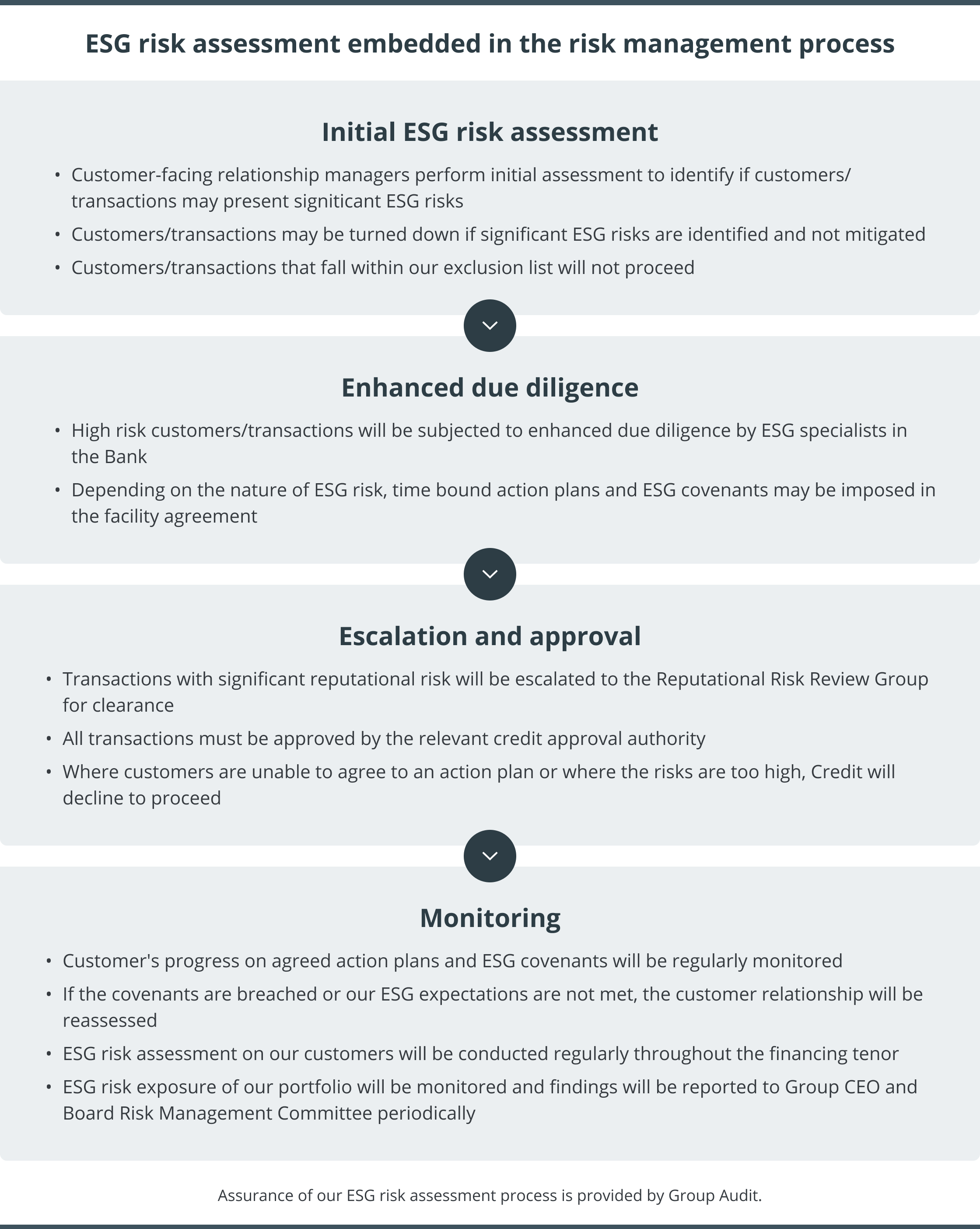

All applicable new and existing corporate, commercial and institutional client transactions are subject to our ESG risk assessment process. We take a risk-based approach towards managing ESG risks where transactions that carry high ESG risks are subject to enhanced evaluation and approval requirements.
Consistent with our overall risk management approach, we manage ESG risks by adopting the Three Lines of Defence model.
OCBC Three Lines of Defence:
- Relationship managers conduct initial ESG risk assessments on their customers.
- Credit approving officers independently review and approve the ESG risk assessments, creating a structure of governance and control.
- Group Audit provides assurance that this process is effective and complies with regulations and our internal standards.
Find out more about our ESG risk assessment process.
Signatory to the Equator Principles

OCBC is a signatory to Equator Principles as an initiative for responsible financing. The Equator Principles is a risk management framework adopted voluntarily by financial institutions to determine, assess, and manage the environmental and social risks associated with financing of large-scale projects such as infrastructure projects to expand transport links and enhance access to basic services such as energy and water.
These include meeting internationally-recognised standards for due diligence and monitoring of projects in accordance with relevant requirements, such as the International Financial Corporation (IFC) Performance Standards and the World Bank Group Environmental, Health and Safety Guidelines.
As a signatory to the Equator Principles, we have integrated requirements from the Equator Principles into our ESG Risk Assessment Process for transactions within the scope of the Equator Principles. In 2021, an Equator Principles Implementation Procedure was established to provide relationship managers with detailed guidance on conducting ESG risk assessment for applicable transactions.
Find out more about the Equator Principles.
Signatory to United for Wildlife Financial Taskforce
OCBC is a member of the United for Wildlife Financial Taskforce, a leading global effort to combat illegal wildlife trade. We recognise that the illegal wildlife trade — among the five most lucrative global crimes — has a devastating impact on the dwindling populations of endangered wildlife left in the world. We are committed to ensuring that the Bank does not facilitate or tolerate financial flows derived from the illegal wildlife trade and the corruption associated with it, such as the sale of illegal wildlife products.