


 Back to listing
FX & Commodities
September 2026
Gold medium-term outlook still positive
Fed Chair Kevin Warsh made clear at Jackson Hole that policy need not remain on hold if price pressures prove persistent. While Warsh’s comments may temper near-term upside for gold, the broader medium-term backdrop remains constructive.
Christopher Wong
Executive Director,
FX Strategist,
OCBC Group Research,
OCBC
Oil
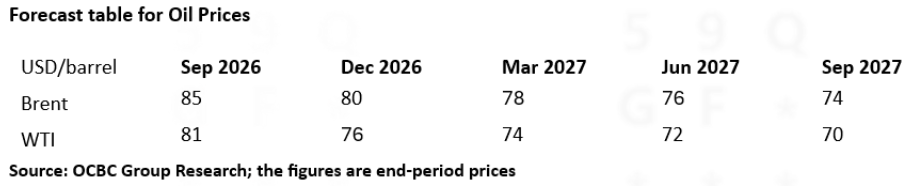
More than five months into the Middle East conflict, oil prices continue to be shaped primarily by geopolitical developments. We have raised our end-2026 Brent forecast to US$80/barrel from US$75/barrel, reflecting our expectation that the recovery in Middle East supply will be slower than previously anticipated, as US-Iran negotiations over the reopening of the Strait of Hormuz remain stalled.
So far, the global oil market has adapted sufficiently to avoid a significant crude shortage. Gulf producers have redirected exports through alternative routes, while the expanded use of "dark" shipping networks has helped maintain flows through the Strait of Hormuz.
However, this resilience is coming at an increasing cost. Inventories are being drawn down, freight costs continue to rise, and refined fuel markets are coming under growing pressure. As a result, the market's overall buffer is steadily eroding.
Strategic reserves provide less protection than they once did. Drawdowns from the US Strategic Petroleum Reserve have slowed as stockpiles approach operational minimum levels, leaving inventories near historic lows. China remains a key swing factor. Its sharp decline in oil imports has helped prevent a tighter global market, but this has also been accompanied by falling domestic inventories, reducing another potential source of flexibility.
The most visible signs of stress are now emerging in refined products rather than crude itself. US diesel crack spreads have surged towards US$100/barrel, highlighting severe shortages in middle distillates. Refineries in both the US and China are operating at high utilisation rates, yet inventories remain thin and strategic reserves continue to play an important role in supporting supply.
In short, the oil market has largely adjusted to disruptions in crude supply, but only through the progressive depletion of existing buffers. The key constraint is no longer crude availability. It is diesel.
Precious Metals
Gold
Gold recovered strongly in August as the macro backdrop turned more supportive. Softer US economic data, easing pressure on yields, and a less consistently firm US Dollar helped revive demand. Investor participation also improved alongside the price recovery, with gold ETF holdings edging higher and managed-money net long positions rebuilding from earlier lows.
The Jackson Hole outcome, however, introduced a more cautious note. Federal Reserve Chairman Kevin Warsh made it clear that policy does not necessarily need to remain on hold if inflationary pressures prove persistent. This suggests that gold's path higher is unlikely to be linear. Following August's strong rebound, the phase of the rally will likely require a fresh macro catalyst rather than simply an extension of the recent supportive trends.
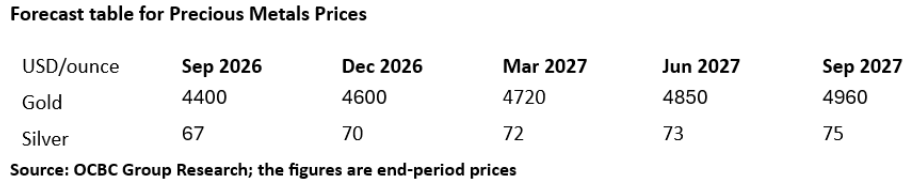
Looking ahead, the focus shifts back to incoming US economic data. Further signs of economic softness, renewed ETF accumulation, and any moderation in yields or the US Dollar could provide the next catalyst for gold. At the same time, central bank purchases, reserve diversification, and concerns over fiscal credibility continue to offer important structural support. Against this backdrop, we have revised our gold price forecasts higher, while still expecting periods of consolidation following the recent rebound.
Silver
Silver outperformed gold in August, benefiting from the same improvement in yields and the US Dollar backdrop, but with a stronger response due to its higher-beta characteristics. Investment participation also strengthened, with both ETF holdings and futures positioning recovering from relatively subdued levels. This suggests there is still scope for further investor engagement should the precious metals rally continue.
The outlook remains constructive, although silver is likely to remain more sensitive than gold to fluctuations in US interest rates and the US Dollar. A more supportive macro environment could allow silver to continue outperforming, while renewed upward pressure on real yields would likely result in a sharper correction.
Over the longer term, structural supply constraints and demand driven by electrification, grid investment, and technology-related applications remain supportive. That said, higher prices are encouraging some degree of thrifting and substitution across industrial uses. Reflecting the stronger starting point and improving investment backdrop, we have revised our silver price forecasts higher. However, given the strength of the recent rally, we remain more measured on the scope for additional near-term upside.
Currency
US Dollar (USD)
We have updated our forecasts to reflect recent market moves following USD weakness driven by policy uncertainty. Sentiment was unsettled by the Treasury's surprise EURJPY (Euro-Japanese Yen) intervention and expanded Treasury buyback plans. However, we maintain a modestly bullish USD outlook into early 2027.
Concerns over currency debasement have eased following Federal Reserve Chairman Warsh's Jackson Hole speech, which helped reinforce confidence in the Fed's commitment to controlling inflation. His remarks were notably more hawkish than those delivered at the July FOMC press conference. Market reactions also resembled the post-June FOMC pattern, with investors refocusing on inflation risks and policy credibility. A resilient labour market, persistent inflation, and the Fed's determination to preserve its anti-inflation credentials should keep policy biased towards tightness and continue to support the USD.
Japanese Yen (JPY)
The BOJ appears increasingly open to raising rates again in September, although it may struggle to exceed already aggressive market expectations. Japan's rates market is pricing roughly a 90% probability of a September hike, followed by a faster pace of policy normalisation thereafter. Current market pricing implies the policy rate rising from 1.00% to 1.75% by June 2027.
Given the constraints on how quickly and how far the BOJ can tighten, additional rate hikes alone may not be sufficient to counter persistent depreciation pressures on the JPY. Further policy measures may eventually be required, including initiatives aimed at encouraging the repatriation of overseas assets.
Australian Dollar (AUD)
Our base case remains that the RBA has reached the end of its current tightening cycle. Nevertheless, stronger-than-expected inflation and resilient household spending have kept the possibility of another rate hike alive.
We remain constructive on the AUD over the next one to two quarters, supported by attractive carry and the prospect of additional policy stimulus from China. While we continue to expect the RBA to remain on hold, sticky inflation means another rate increase cannot be ruled out. Over the medium term, however, we expect the AUD to surrender some of its gains as inflation moves closer to target and the RBA gradually shifts away from a restrictive policy stance.
Asia ex-Japan Currencies (AXJ FX)
Asia ex-Japan currencies traded mixed in August, with domestic policy developments, growth dynamics, and capital flows at times offsetting the influence of the USD and US rates. Jackson Hole introduced a modest headwind but did not fundamentally alter this picture.
Fed Chair Warsh reinforcing the Fed's anti-inflation credibility and keeping the door open to further tightening if inflation fails to ease meaningfully may keep the USD supported. A firmer USD may create headwinds for AXJ FX, but it is unlikely to eliminate the differentiated opportunities across the region. At the same time, USD pullbacks may prove shallower unless softer US data revive expectations of a less hawkish Fed trajectory. Consequently, US labour market and inflation data will be key focal points ahead of the September FOMC meeting.
Renminbi (RMB)
The RMB strengthened further in August, supported by exporter conversions, still-solid external balances, and periods of broader USD weakness. The domestic backdrop remains uneven, however, with economic momentum still soft and property-sector support remaining targeted rather than broad-based.
We continue to expect a gradual appreciation bias rather than a sharp RMB rally. While a firmer USD may slow the pace of gains in the near term, policymakers' preference for exchange-rate stability should help limit downside risks. We will continue to monitor the daily fixing closely for signals regarding policy intent.
Singapore Dollar (SGD)
The Singapore Dollar remained relatively resilient in August, supported by robust domestic fundamentals and the modestly tighter S$NEER (Singapore Dollar Nominal Effective Exchange Rate) policy stance adopted in July.
For now, external factors are likely to remain the primary drivers, particularly RMB direction, broad USD trends, and US interest-rate developments. We continue to see scope for the SGD to outperform many regional peers, although sustained downside in USDSGD may be more difficult to achieve unless softer US data trigger a more dovish reassessment of the Fed outlook.
Malaysian Ringgit (MYR)
The Malaysian ringgit strengthened in August as domestic growth remained firm and export performance continued to hold up well. Political uncertainty has also eased somewhat, with the prospect of an early general election appearing less immediate.
We believe the MYR can remain relatively resilient into September, supported by solid domestic fundamentals. However, a firmer USD and higher US yields could limit the pace of appreciation, while Bank Negara Malaysia's September policy meeting represents the next key near-term catalyst.
Indonesian Rupiah (IDR)
The Indonesian rupiah stabilised in August as lower oil prices reduced a key external headwind, while policy continuity at Bank Indonesia helped support investor sentiment.
We continue to see scope for a selective recovery should oil prices remain contained and US yields stabilise. However, the post-Jackson Hole backdrop argues against expecting a straightforward extension of recent gains. The IDR is likely to remain sensitive to movements in the USD, global interest rates, and portfolio flows, with currency stability remaining a near-term policy priority.
The information provided herein is intended for general circulation and/or discussion purposes only. It does not take into account the specific investment objectives, financial situation or particular needs of any particular person. The information in this document is not intended to constitute research analysis or recommendation and should not be treated as such.
Without prejudice to the generality of the foregoing, please seek advice from a financial adviser regarding the suitability of any investment product taking into account your specific investment objectives, financial situation or particular needs before you make a commitment to purchase the investment product. In the event that you choose not to seek advice from a financial adviser, you should consider whether the product in question is suitable for you. This does not constitute an offer or solicitation to buy or sell or subscribe for any security or financial instrument or to enter into a transaction or to participate in any particular trading or investment strategy.
The information provided herein may contain projections or other forward looking statement regarding future events or future performance of countries, assets, markets or companies. Actual events or results may differ materially. Past performance figures are not necessarily indicative of future or likely performance. Any reference to any specific company, financial product or asset class in whatever way is used for illustrative purposes only and does not constitute a recommendation on the same. Investments are subject to investment risks, including the possible loss of the principal amount invested.
The Bank, its related companies, their respective directors and/or employees (collectively “Related Persons”) may or might have in the future interests in the investment products or the issuers mentioned herein. Such interests include effecting transactions in such investment products, and providing broking, investment banking and other financial services to such issuers. The Bank and its Related Persons may also be related to, and receive fees from, providers of such investment products.
No representation or warranty whatsoever (including without limitation any representation or warranty as to accuracy, usefulness, adequacy, timeliness or completeness) in respect of any information (including without limitation any statement, figures, opinion, view or estimate) provided herein is given by OCBC Bank and it should not be relied upon as such. OCBC Bank does not undertake an obligation to update the information or to correct any inaccuracy that may become apparent at a later time. All information presented is subject to change without notice. OCBC Bank shall not be responsible or liable for any loss or damage whatsoever arising directly or indirectly howsoever in connection with or as a result of any person acting on any information provided herein.
The contents hereof may not be reproduced or disseminated in whole or in part without OCBC Bank's written consent. The contents are a summary of the investment ideas and recommendations set out in Bank of Singapore and OCBC Bank reports. Please refer to the respective research report for the interest that the entity might have in the investment products and/or issuers of the securities.
Investments are subject to investment risks, including the possible loss of the principal amount invested. The information provided herein may contain projections or other forward-looking statements regarding future events or future performance of countries, assets, markets or companies. Actual events or results may differ materially. Past performance figures, predictions or projections are not necessarily indicative of future or likely performance.
This advertisement has not been reviewed by the Monetary Authority of Singapore.
This document may be translated into the Chinese language. If there is any difference between the English and Chinese versions, the English version will apply.
Foreign Currency disclaimer
- Foreign currency investments or deposits are subject to inherent exchange rate fluctuation that may provide opportunities and risks. Consequently, exchange rate fluctuations may affect the value of your foreign currency investments or deposits.
- Earning on foreign currency investments or deposits may change depending on the exchange rates prevalent at the time of their maturity if you choose to convert.
- Exchange controls may apply to certain foreign currencies from time to time.
- Any pre-termination costs will be taken and deducted from your deposit directly and without notice.
Cross-Border Marketing Disclaimers
OCBC Bank's cross border marketing disclaimers relevant for your country of residence.
Collective Investment Schemes
- A copy of the prospectus of each fund is available and may be obtained from the fund manager or any of its approved distributors. Potential investors should read the prospectus for details on the relevant fund before deciding whether to subscribe for, or purchase units in the fund.
- The value of the units in the funds and the income accruing to the units, if any, may fall or rise. Please refer to the prospectus of the relevant fund for the name of the fund manager and the investment objectives of the fund.
- Investment involves risks. Past performance figures do not reflect future performance.
- Any reference to a company, financial product or asset class is used for illustrative purposes and does not represent our recommendation in any way.
- For funds that are listed on an approved exchange, investors cannot redeem their units of those funds with the manager or may only redeem units with the manager under certain specified conditions. The listing of the units of those funds on any approved exchange does not guarantee a liquid market for the units.
- The indicative distribution rate may not be achieved and is not an indication, forecast, or projection of the future performance of the Fund.
Any opinions or views of third parties expressed in this document are those of the third parties identified, and do not represent views of Oversea-Chinese Banking Corporation Limited (“OCBC Bank”, “us”, “we” or “our”).